Divesting from Destructive Corporations

In a recently published article, Naomi Klein elaborates on the Gates Foundation’s short-sighted and hypocritical actions. Klein discusses a growing movement pressuring public interest institutions to divest their holdings from corporations which are destroying the public’s general welfare.

As she points out, environmental organizations themselves ought to “make absolutely sure that the money they have raised in the name of saving the planet is not being invested in companies whose business model requires cooking the planet…”

In regards to the Gates Foundation, on one hand, the Foundation claims to fight world hunger, but, on the other hand, the Foundation invests in Monsanto, a corporation notorious for perpetuating hunger and poverty. Another example Klein points out is the Foundation’s nearly billion dollars investment in the oil giants ExxonMobil and BP. According to Klein, “The hypocrisy is staggering: a top priority of the Gates Foundation has been
malaria research, a disease intimately linked to climate. Mosquitoes and malaria parasites can both thrive in warmer weather…does it really make sense to fight malaria while fueling one of the reasons it may be spreading more ferociously?”

AGRA Watch urges the Gates Foundation to not only reconsider the investments they have made in “companies whose business model requires cooking the planet” but to also to divest from biotech companies supporting unsustainable solutions to hunger.To learn more, please visit Naomi Klein’s article “The Giants of the Green World that Profit from the World’s
Destruction.”


Support Biodiversity not Biofortification

In another shortsighted attempt to combat malnutrition, the Bill and Melinda Gates Foundation has granted more than 8 million dollars to Australia’s Queensland University of Technology (QUT) for the development of genetically modified and nutrient-fortified bananas. Professor James Dale heads the QUT fortification project which plans to bring the engineered bananas to malnourished populations in Uganda and India. However, according to Dr. Vandana Shiva, the answer to malnutrition lies in increasing biodiversity rather than industrially engineering or “fortifying” crops. As history has shown, GM crops resulted in the proliferation of monocultures and the depletion of biodiversity– biodiversity which naturally supplied crops rich in iron and nutrients. As Shiva explains, “Any woman will tell you that the solution to malnutrition lies in growing nutrition, which means growing biodiversity…we don’t need these irresponsible experiments that create new threats for biodiversity and our health; we don’t need nutrient solutions imposed by powerful men sitting in distant places, who are totally ignorant of the biodiversity in our fields and who won’t have to bear the consequences of their destructive power…”

To learn more, see Vandana Shiva’s article Bill Goes Bananas!


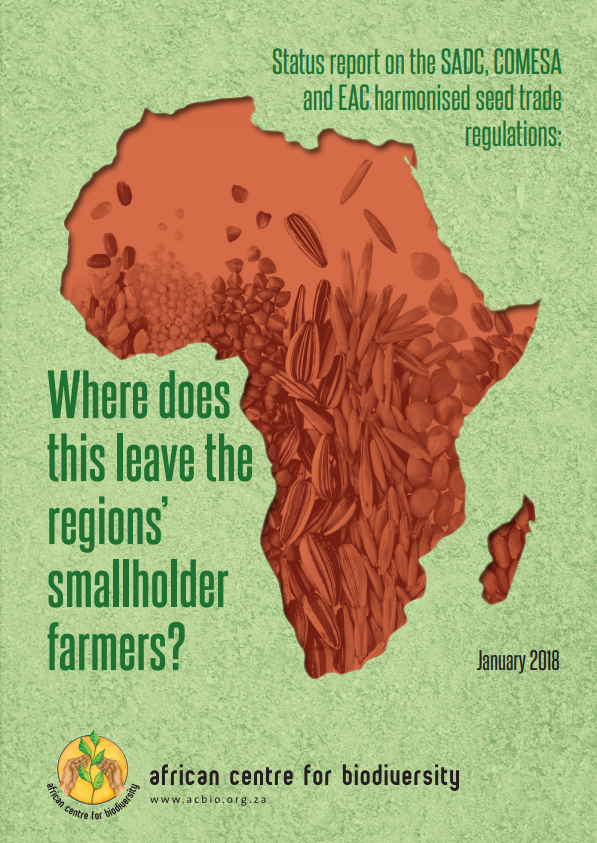
Control of Africa’s Seed

In an article titled “Is Africa about to Lose the Right to Her Seed?” Glenn Ashton discusses how the international seed industry is threatening Africa’s food security, agricultural integrity and traditional methods of seed saving. As Ashton explains, the World Bank, The American Seed Association, government agencies, philanthropists and biotech companies all aim “to create a harmonised system of control around the presently fragmented African seed trade regime and create a system based on what is projected as modern best practice.” However, this “system of harmonized control” includes Africa’s obligation to strictly adhere to the 1991 Act of the International Union for the Protection of Plant Varieties (UPOV). “Because of the stringency of UPOV, the real impact of this will be the loss of control of the seed supply by indigenous small farmers. The consequences for food production and social cohesion across the continent will be dire,” Ashton explains.

Although, organizations such as the Alliance for a Green Revolution in Africa (AGRA) suggest that new seeds being developed will be freely shared to benefit smallholder farmers, AGRAWatch contends that the reality of imposing restrictive, neo-colonial regulations on the heart of Africa’s agriculture will only perpetuate insecurity and conflict for peasant farmers.

For more information on Glenn Ashton’s piece, please visit The South African Civil Society Information Service.


Biotech Industry’s Need for Selective Science

The on-going debates regarding whether or not GM food is safe for human consumption involve GM proponents relying on short-term research studies which do not allow for sufficient data collection to gauge the long-term and multigenerational effects of GM food consumption. Because some other studies have indicated that there are likely to be adverse health effects after long-term GM consumption AGRA Watch believes that independent scientific long-term research studies must be performed in order to enlighten the GM debate.

In a recently published article titled, “The State of Science“, Dr. Stuart Newman highlights the proliferation of GM crops despite the absence of long-term studies analyzing the effects of these crops on human health. According to Dr. Newman’s analysis, proponents of genetically modified foods are quick to dismiss opponents’ “reservations about the massive introduction of GM food into the food chain” as “scientifically ignorant, economically suicidal, and cruel to the world’s hungry.” Consequently, the biotech industry has relied upon lax regulations and superficial “scientific” studies to achieve lucrative profits from the transformation of traditional US crops to GM crops. Dr. Newman succinctly summarizes the issue and states, “To protect its investment against a skeptical public, the biotech food industry has depended on compliant regulators, on its proponents’ ridicule of biotech industry critics’ supposed scientific ignorance, and on expensive campaigns against labeling of prepared foods that would draw undue attention to the presence of GM components.”

If interested in learning more, please visit the Council for Responsible Genetics.

Obama Administration Signs Monsanto Protection Act

Legislation was passed last week to continue funding the US government.
Regrettably, this legislation also included a provision titled the Farmer Assurance Provision (dubbed by critics as the Monsanto Protection Act) which works to protect GE seeds from litigation.
AGRA Watch disapproves of this provision because it allows the biotech industry to evade regulatory and judicial review, therefor, permitting the industry to set its own conditions to sell GE seeds. A blog posted by Doug Gurian-Sherman of Union of Concerned Scientists, states “The so-called biotech rider (S. 735), attached to the continuing resolution in the U.S. Senate, was designed to override successful lawsuits. It would overturn rulings by the courts that have protected citizens from U.S. Department of Agriculture (USDA) actions that subvert the legal obligations of the agency to protect farmers and the environment.”
The bill is set to expire in six months, and it remains unclear whether or not the provision will be short-lived. However, as Gurian-Sherman asserts, “Once a country throws open its doors to the biotech industry, it can expect a similar effort to weaken regulations for food safety and environmental protection.”
If interested in learning more, a recent Salon article titled How Monsanto Outfoxed the Obama Administration, also discusses how the biotech industry influences government regulations.

Gates’ Sam Dryden hails Mark Lynas on GM

Mark Lynas, claiming to be an early GM opponent, is now the biotech industry’s darling as he recants the errors of his ways.
In a speech given at the Oxford Farming Conference, Lynas apologized for having “spent several years ripping up GM crops… [and for helping] to start the anti-GM movement back in the 1990s…”
The Gates Foundation has picked up the industry spin and in a blog posted by Sam Dryden, the Gates Foundation’s director of agricultural development, Dryden discusses how “refreshing” it was to hear Lynas apologize for the “myths” he spread about GMOs during his time as a self-proclaimed anti-GMO activist.
AGRA Watch urges readers to visit Johnathan Matthews’ articles for GMWatch, The Repentant Environmentalist: Part one and Part two, in which Matthews  debunks Lynas’ claims and discusses whether Lynas’ speech isn’t “best understood as a PR narrative.”
Additionally, the Bioscience Resource Project has compiled a list of recent articles from experts putting the Lynas scientific misrepresentation into perpective.

IRRI Sets Record Straight on Golden Rice

The Bill & Melinda Gates Foundation has granted the International Rice Research Institute in the Philippines $1.3 million to help develop Golden Rice, a genetically modified strain of rice containing beta-carotene which the body may be able to convert to vitamin A.

In recent weeks, two news stories broke hyping up the expectations of Golden Rice.
In a response to the exaggerated news stories, the International Rice Research Institute issued a clarifying statement.
Michael Hansen, senior scientist at Consumers Union, has also discussed the hype regarding Golden Rice’s claim to combat vitamin A deficiency. According to Hansen, there have been three versions of the genetically modified rice varieties to date. The first version (GR1) had low levels of beta-carotene– a precursor to vitamin A–so low in fact, that a report by Greenpeace exposed that an individual would have to consume TEN pounds of the rice in order to get the desired levels of beta-carotene. Although the second version (GR2) had higher levels of beta-carotene, the real issue, Hansen states, was that because the genes were easier to insert in japonica varieties of rice, people in South Asia (who were accustomed to indica rice) would not eat the new variety. “It wasn’t until 2010 that they had been able to cross GR2 with local indica varieties and get plants out into the field to test. We still don’t know the levels of beta-carotene in the GR indica varieties. In addition, they still haven’t done the proper safety testing…” says Hansen.

Furthermore, according to Vandana Shiva, in one village she is familiar with, over 350 varieties of plants grow (dismissed as “weeds”) which are dietary sources of vitamin A. It is also likely that without other nutrients in a balanced diet, the child’s body may not be able to manufacture vitamin A from the precursors.

Regrettably, if an adequately nutritious and safe to consume variety of Golden Rice is ever developed, it would be foolish to assume that this technology would be made available to those who need in most, without prioritizing corporate interest. In a piece posted on GM-Free Cymru, Dr. Brian John writes, “The idea that Golden Rice is being ‘given to the world’ as a grand humanitarian gesture, with the high-profile support of the Rockefeller and Gates Foundations, is a scam — as realised by many observers even in the early days of the project. Syngenta owns the patents and the commercial rights in Golden Rice. It is not ‘giving away’ the technology but sub-licensing it with very specific conditions…So Syngenta keeps ownership, spreads the financial risk, accepts no liability, undermines the regulatory system, puts moral pressure on those who stand in the way of its ambitions, and still stands to make a killing if anybody (other than a small farmer) grows any Golden Rice hybrid in the future.”


Follow

Get every new post delivered to your Inbox.